Andrew Rapp
Coercive/Intolerable Acts
Enactment-Repeal
The first part of the Intolerable Acts was passed on March 30, 1774 but there was never a repeal date of the act as the Revolutionary War soon thereafter won the United States Independence from Britain so there was no need to get the Act officially repealed (Hickman).
Purpose
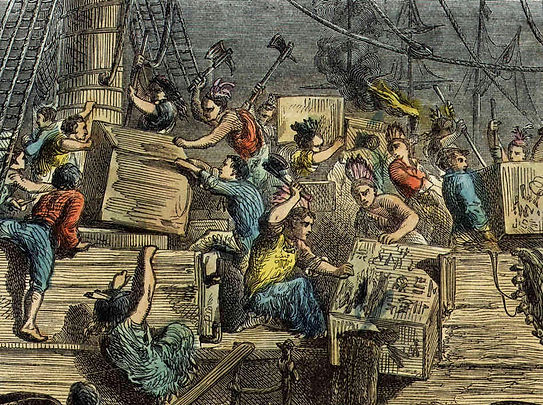
The purpose of the British passing this act was in revenge for the recent Boston Tea Party but also in hopes of subduing the rowdy Boston groups (USHistory.org). The idea behind the Intolerable Acts is to try to regain control of the colonists hoping to teach them that they were still part of the British Empire (USHistory.org).
Provisions
The Parliament created four acts in 1774: Boston Port Act, Massachusetts Government Act, Administration of Justice Act, and the Quebec Act (Brinkley, 108). The four of these were combined under a common name which the British called the Coercive Acts while the American colonists cleverly came up with the title the Intolerable Acts. The Boston Port Act refused any trade to go on in the port of Boston until the colonists repaid the British for all the goods they destroyed (USHistory.org). Anyone who smuggled in goods through the bay would be imprisoned and any ship anchored near the surrounding Islands would be asked to leave (Ashbrook). The Massachusetts Government Act took away lots of the power from the Massachusetts colonists and gave more power to the king (USHistory.org). General Gage was appointed new governor of the area and he brought along with him a large military force (USHistory.org). Military officers could choose private houses to house their troops in and colonists had no say in turning away the soldiers from their houses (Brinkley, 108). Administration of Justice Act allowed British soldiers to be tried in court in other countries and even England (USHistory.org). This allowed soldiers to be pardoned of their crimes and allowed to return back to America instead of being tried in court by colonists who would have found them guilty (Wahlke, 47). Finally the Quebec Act gave Quebec to the French which countered colonial hopes of capitalizing on the wealth that could be gained from the territory (USHistory.org). The Act also allowed for further religious tolerance by including the Roman Catholic church (Brinkley, 108). The colonists believed the British had something afoot and were going to subject Americans under the Pope's authority (Brinkley, 108).
Who was affected
The colonists were greatly affected by the Acts as they limited the colony's say in their own treatment (Wahlke, 47). Pretty much the Acts allowed the British crown to have full control of the Massachusetts area giving the Bostonians no say in their own government. The area also struggled due to loss in trade so merchants were deeply affected. Also to add insult to injury British troops could at any moment claim holding on your house and take colonial supplies (Brinkley, 108).
Colonial response
The other colonies quickly responded by shipping goods by land to the Massachusetts area strengthening colonial bonds (USHistory.org). Seeing the colonies support countering the British Acts the First Continental Congress was called in Philadelphia on September 7, 1774 (USHistory.org). This was the beginning of the end for the British control of the United States as soon thereafter the Revolutionary War began pushing the British out.
Relations with Britain
The Coercive Act backfired on the British who hoped to regain colonial support. Instead a new rebelious flame arose in the colonies and the First Continental Congress was formed which later lead to the Revolutionary War which broke off relations with the British.
Citations
Pictures
Background- http://i.huffpost.com/gen/878088/thumbs/o-BOSTON-TEA-PARTY-facebook.jpg
Boston Tea Party- http://3.bp.blogspot.com/-Nhqee-ZeDGM/U7z38ugc82I/AAAAAAAAD1M/OP7hhYYZn_4/s1600/the+boston+tea+party.jpg
British Parliament- http://www.cr-cath.pvt.k12.ia.us/lasalle/Resources/Rev%20War%20Websites/rev%20war%20kayceeashleymeganbridgetsarah/Kaycee%20Revolutionary%20War/images/intolerable%20acts.jpeg
Boston Harbor- http://4.bp.blogspot.com/_yE1jakaG6kk/TAm295j5chI/AAAAAAAACag/u__X_UkIvAs/s1600/boston+harbor.jpg
First Continental Congress- http://www.sonofthesouth.net/revolutionary-war/political/continental-congress.jpg
American Revolution- http://www.aljazeera.com/mritems/Images/2011/3/7/20113714026398876_20.jpg
Brinkley, Alan. "Tea Excitemnet." The Unfinished Nation: A Concise History of the American People. Boston: McGraw-Hill, 2010. 107-09. Print.
Wahlke, John C. "An Aftermath of the GreatWar for the Empire." The Causes of the American Revolution. Boston: Heath, 1962. 47-48. Print.
Ashbrook Center. "Coercive Acts | Teaching American History." Teaching American History. Ashland University, n.d. Web. 18 Oct. 2015.
"The Intolerable Acts." Ushistory.org. Independence Hall Association, n.d. Web. 18 Oct. 2015.
"The Intolerable Acts ACTION CENTER." The Intolerable Acts ACTION CENTER. Pariot Coalition, n.d. Web. 18 Oct. 2015.
Hickman, Kennedy. "What Were the Intolerable Acts?" About.com Education. N.p., n.d. Web. 18 Oct. 2015.
"The Intolerable Acts." Ushistory.org. Independence Hall Association, n.d. Web. 18 Oct. 2015.